
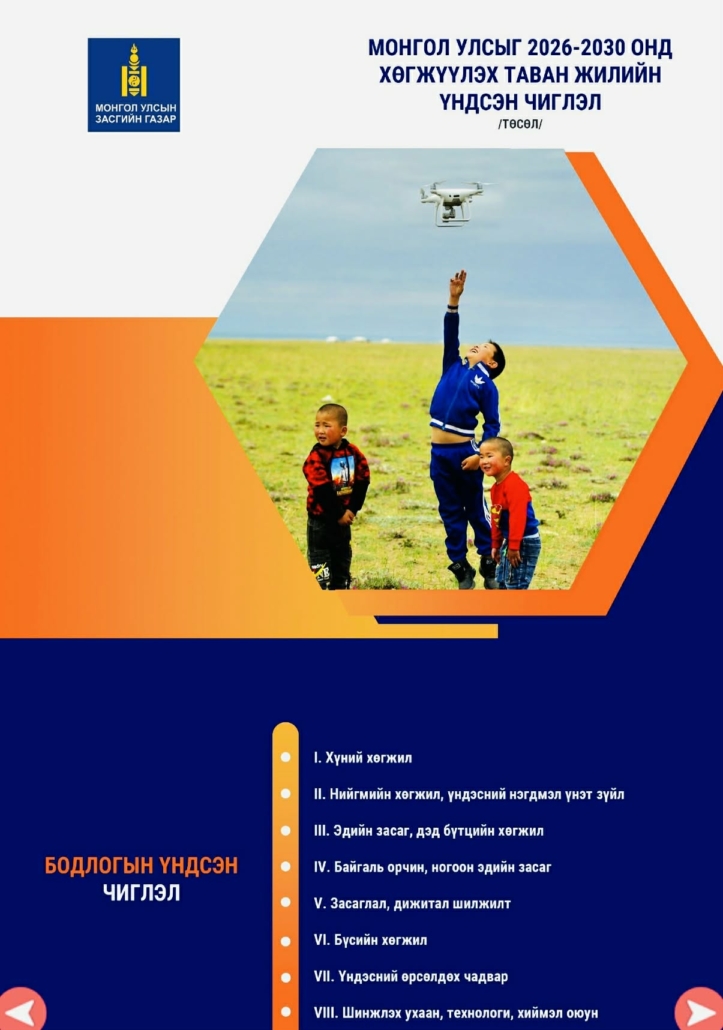
Mongolia Submits the Draft Five-Year Development Guidelines for 2026–2030
The Government of Mongolia submitted the draft resolution on approving the “Five-Year Development Guidelines of Mongolia for 2026–2030” to the State Great Khural (Parliament) on October 30, 2025.
The draft Guidelines were developed through discussions with scholars and researchers from the Mongolian Academy of Sciences, research institutions, and universities. Following the adoption of the Law on Development Policy and Planning in 2020, Mongolia approved its first-ever Five-Year Development Guidelines. In accordance with this law, the next five-year plan must be submitted to Parliament two months before the conclusion of the previous one. Accordingly, the draft “Five-Year Development Guidelines of Mongolia for 2026–2030” has been developed and submitted to Parliament.
The draft Guidelines are aligned with the “Vision 2050” Long-Term Development Policy of Mongolia and the Government Action Program for 2024–2028. The document consists of eight policy areas: Human Development; Social Development and National Unity; Economic and Infrastructure Development; Environment and Green Economy; Governance and Digital Transformation; Regional Development; National Competitiveness; and Science, Technology, and Artificial Intelligence. Within these, it defines 10 national outcomes, 35 sectoral outcomes, 85 program-level objectives, and 200 measurable results.
A notable feature of this policy document is the inclusion of ten national outcomes across the eight policy areas. For instance, by improving the level of processing in the manufacturing sector, enhancing productivity and diversification, the Guidelines aim to maintain stable economic growth above 6 percent.
The draft also sets the goal of reducing regional disparities, diversifying local economies, and balancing internal migration, thereby increasing regional development indicators by 20 percent. It envisions an improved business environment by reducing state involvement in the market, promoting fair competition, protecting the rights and interests of entrepreneurs and investors, and deepening tax and customs reforms — aiming for Mongolia to rank among the top 50 countries in global competitiveness within the next five years.
In the education and health sectors, the reform aims to ensure equitable access to quality services for all citizens, develop human resources aligned with labor market demand, and raise the Human Development Index (HDI) to 0.813. The policy also seeks to improve the linkages between labor relations, wages, and social insurance; increase employment; reduce workplace accidents and labor disputes; promote decent work; and expand the middle class by 20 percent.
Measures to reduce corruption, strengthen public trust in the judiciary and the rule of law, improve transparency and accountability, and enhance defense and national resilience are also reflected in the draft. Additionally, it aims to implement the principle of “Digital by Default,” ensuring citizen-centered public services and positioning Mongolia among the top 90 countries in governance indicators.
🔗 For more details, please visit:
Five-Year Development Guidelines of Mongolia for 2026–2030 | PDF to Flipbook
МОНГОЛ УЛСЫГ 2026-2030 ОНД ХӨГЖҮҮЛЭХ ТАВАН ЖИЛИЙН ҮНДСЭН ЧИГЛЭЛ | PDF to Flipbook

